
Smart PDU: outlet-level metering and remote control for rack infrastructure
A smart PDU distributes rack power while telling you what each outlet is drawing and letting you switch it remotely. This page explains the four PDU types, where each one belongs, and which Xtreme Power unit fits your rack. If you already know what you need, skip to choosing a model.

What a smart PDU does, and what it doesn’t
A smart PDU is a rack power distribution unit with a network interface. It takes one circuit in and splits it across multiple outlets, the same as any PDU. What makes it smart is that it measures what it is delivering and accepts commands about what to deliver next. Manufacturers also sell these as intelligent PDUs or managed PDUs. The labels are interchangeable; the capability set is what matters.
Watts and accumulated energy per outlet, not just a total for the strip. This is what makes capacity planning and chargeback possible.
Power-cycle a specific device from anywhere. Recovers a hung switch or modem without dispatching anyone to the site.
Feeds your existing monitoring platform. Thresholds trigger email or SMS before a circuit reaches its limit.
What it does not do is provide backup power. A smart PDU has no battery. When the utility fails, everything downstream of it goes dark unless a UPS sits upstream. This is the single most common misunderstanding about the product category, and it is worth being direct about before you specify anything.
The four types of rack PDU
PDUs are classified by how much they measure and whether they can act. Cost rises with each step, so the useful question is which capability you will actually use rather than which unit has the most features.
| Type | Metering | Switching | Typical use |
|---|---|---|---|
| Basic | n/a | n/a | Distribution with branch circuit protection. Correct choice when the rack is attended and the load is well understood. Surge suppression comes from the XPDS rather than the XPDU. |
| Metered | Aggregate | n/a | Total draw for the strip. Enough to know how close a circuit is to its limit. |
| Metered-by-outlet | Per outlet | n/a | Device-level consumption data for capacity planning, chargeback, and finding the load you did not know about. |
| Switched & metered | Per outlet | Per outlet | Full visibility plus remote reboot. The configuration that eliminates truck rolls at unattended sites. |
The Xtreme Power SPDU Series is switched and metered-by-outlet, the top row of that table. If your requirement stops at distribution and surge protection, the XPDU Series is the more sensible spend.
UPS and smart PDU: different jobs in the same rack
These are complementary, not alternatives. A rack that needs both should have both, and the order matters: utility feeds the UPS, the UPS feeds the PDU, the PDU feeds the equipment.
- Rides through utility outages on battery
- Conditions voltage and filters transients
- Allows graceful shutdown or generator handoff
- Has no per-outlet control
- Splits one circuit across many outlets
- Meters consumption device by device
- Switches individual outlets remotely
- Has no battery and no ride-through
A useful test: if the problem is the power went out, you need a UPS. If the problem is the device is hung and nobody is on site, you need a switched PDU. Most distributed sites eventually have both problems.
When a smart PDU earns its cost
A smart PDU costs more than a basic one, and in an attended data center with generous circuit headroom the difference can be hard to justify. It pays for itself quickly in these situations:
- → Unattended edge or remote sites where any visit costs a truck roll
- → MSPs managing racks across multiple client locations
- → Circuits running close enough to capacity that you need real numbers
- → Equipment that hangs and needs a hard power cycle to recover
- → Colocation or internal chargeback requiring per-device consumption
- → Network closets and telecom rooms with no permanent staff
- → Non-conditioned spaces where rack temperature needs watching
- → Federal and public-sector work with TAA procurement requirements
If none of those describe your environment, a basic or metered unit is likely the right answer and we would rather tell you that than sell you capability you will not use.
Choosing the right Xtreme Power PDU
Four product families cover rack distribution. They solve genuinely different problems, so the choice is usually clear once the requirement is stated properly.
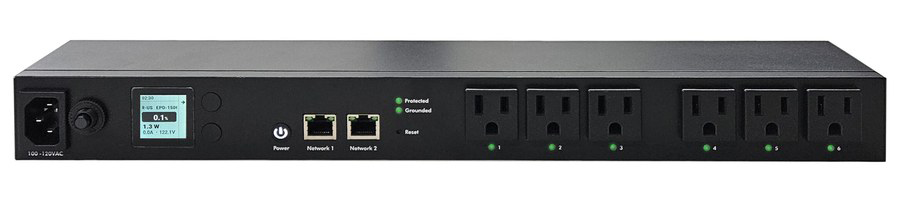
Switched & metered-by-outlet · 5 yr warranty
Per-outlet metering and remote switching with SNMP, secure web management, touch LCD, and integrated temperature monitoring. Auto-reboot on loss of connectivity.
Choose when you need remote reboot, per-device consumption data, or monitoring integration across distributed sites.
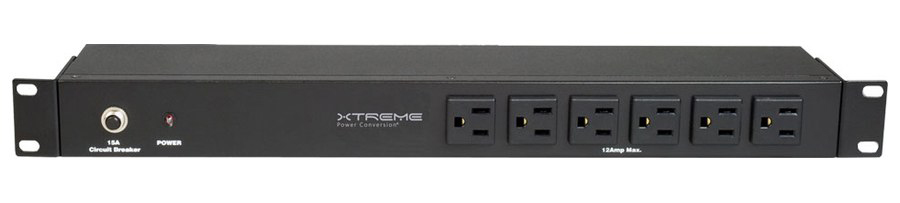
Up to 24 receptacles · 1U, 2U or 0U vertical
Passive rack distribution with UL 1077-listed branch circuit breakers. NEMA, IEC C20, or hardwired input; horizontal or 0U vertical mounting that keeps rack units free for equipment. Works with any manufacturer’s UPS.
Choose when the rack is attended, the load is known, and you need outlet count and the right receptacle mix rather than monitoring.
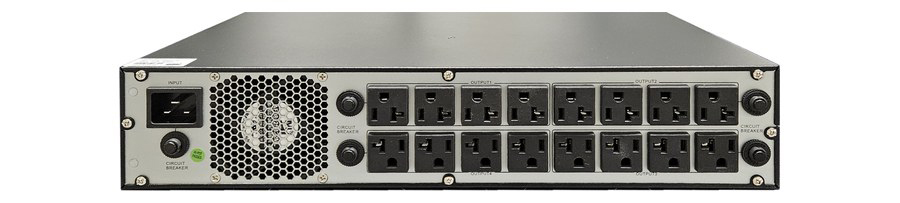
120/208/240V in · 120V or 240/120V out
Galvanic isolation transformer built into the PDU. Separates connected equipment from the upstream source, rejecting common-mode noise and eliminating ground loops, with step-down conversion in mixed-voltage environments.
Choose when the problem is power quality rather than monitoring: medical, laboratory, AV, or industrial loads on a noisy or wrong-voltage service.
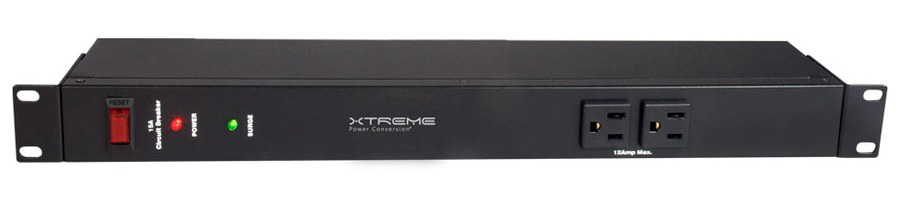
10 outlets (2 front, 8 rear) · 1U or 0U
Surge-protected distribution in an industrial steel chassis, with a front-panel LED that confirms the suppressor is still live. When that light goes out the circuit has taken a catastrophic surge and the unit needs replacing, which is covered free under warranty.
Choose when transients are the threat rather than outages or lockups: AV, telecom, security, and industrial racks on exposed services.
Isolation and intelligence are independent requirements, and they do not chain. Sensitive equipment should plug directly into the isolation PDU: a smart PDU after the transformer adds its own ground path and undoes the isolation. Where a rack needs both, feed each from the UPS: isolation-sensitive equipment on the isolation PDU, and everything that needs metering and remote reboot on the smart PDU. Our sales engineers can confirm the arrangement for your service and load.
SPDU-0615C and SPDU-1415C specifications
Two models, differing in outlet count, form factor, and surge rating. Both share the same management platform.
| Specification | SPDU-0615C | SPDU-1415C |
|---|---|---|
| Outlets | (6) NEMA 5-15R | (14) NEMA 5-15R |
| Form factor | 1U: 17.3 × 2.8 × 1.73 in | 2U: 17.3 × 3.5 × 3.5 in |
| Surge suppression | 1080 J | 3240 J |
| Weight | 2.3 lbs | 5.4 lbs |
| Input | 120 VAC single phase, 12 A continuous, 15 A breaker, IEC C-14 inlet with 6 ft detachable cord | |
| Metering | Per-outlet power monitoring (watts and energy) | |
| Switching | Per-outlet on/off, remote reboot, auto-reboot on connectivity loss | |
| Network | (2) 10/100/1000 Mbps shielded RJ-45; second port is non-cascading pass-through | |
| Management | SNMP and secure web, touch LCD, email and SMS notification | |
| Environmental | Integrated temperature sensing, programmable voltage thresholds | |
| Operating range | 0°C to 50°C, 5% to 95% non-condensing | |
| Mounting | Rack, wall, or desktop | |
| Approvals | UL 62368-1, CSA C22.2 No. 62368-1, UL 1449 ed.5, FCC Class B, TAA compliant | |
| Warranty | 5 years (USA & Canada) | |
Specifications from the SPDU datasheet (Rev 11/3/25). Surge joule rating and outlet count are model-dependent.
Complete specifications, deployment detail, and side-by-side comparisons against APC, Eaton, Vertiv, Raritan, and CyberPower equivalents.
Monitoring, alerting, and capacity planning
A smart PDU is only as useful as the system reading it. The SPDU exposes SNMP and a secure web interface, so it reports into whatever platform you already run rather than requiring another console.
- Threshold alerting. Programmable voltage and load thresholds trigger email or SMS before a circuit trips rather than after.
- Capacity planning. Per-outlet energy data over time shows real headroom, which is usually different from the nameplate arithmetic.
- Environmental context. Integrated temperature sensing matters in closets and non-conditioned spaces where cooling is incidental rather than designed.
- Standardization. One PDU platform across sites means one set of MIBs, one alerting configuration, and one runbook.
Second RJ-45 port note: it is a non-cascading pass-through, so it provides a wired hand-off to an adjacent device rather than daisy-chained PDU management. Worth knowing before you design the topology.
Where the smart PDU sits in rack power design
The distribution layer is one component of a structured rack power design. Specifying it in isolation tends to produce racks that monitor beautifully and still go dark, or racks with hours of runtime and no way to reboot anything remotely.
How UPS capacity, distribution, monitoring, and redundancy fit together, and the sizing decisions that follow from the circuit you actually have.
Smart PDU frequently asked questions
What does a smart PDU do?
What is the difference between a metered PDU and a switched PDU?
What is the difference between a UPS and a smart PDU?
Can a smart PDU reboot a frozen device remotely?
Is a smart PDU the same as an intelligent PDU or a managed PDU?
Do I need an isolation transformer PDU instead?
Are Xtreme Power smart PDUs TAA compliant?
Can smart PDUs be daisy chained?
Talk to an Xtreme Power sales engineer
We will size the distribution layer against your actual circuit, load list, and monitoring platform, and tell you honestly if a basic PDU would serve you just as well.