
M90S Scalable Infrastructure Power Platform
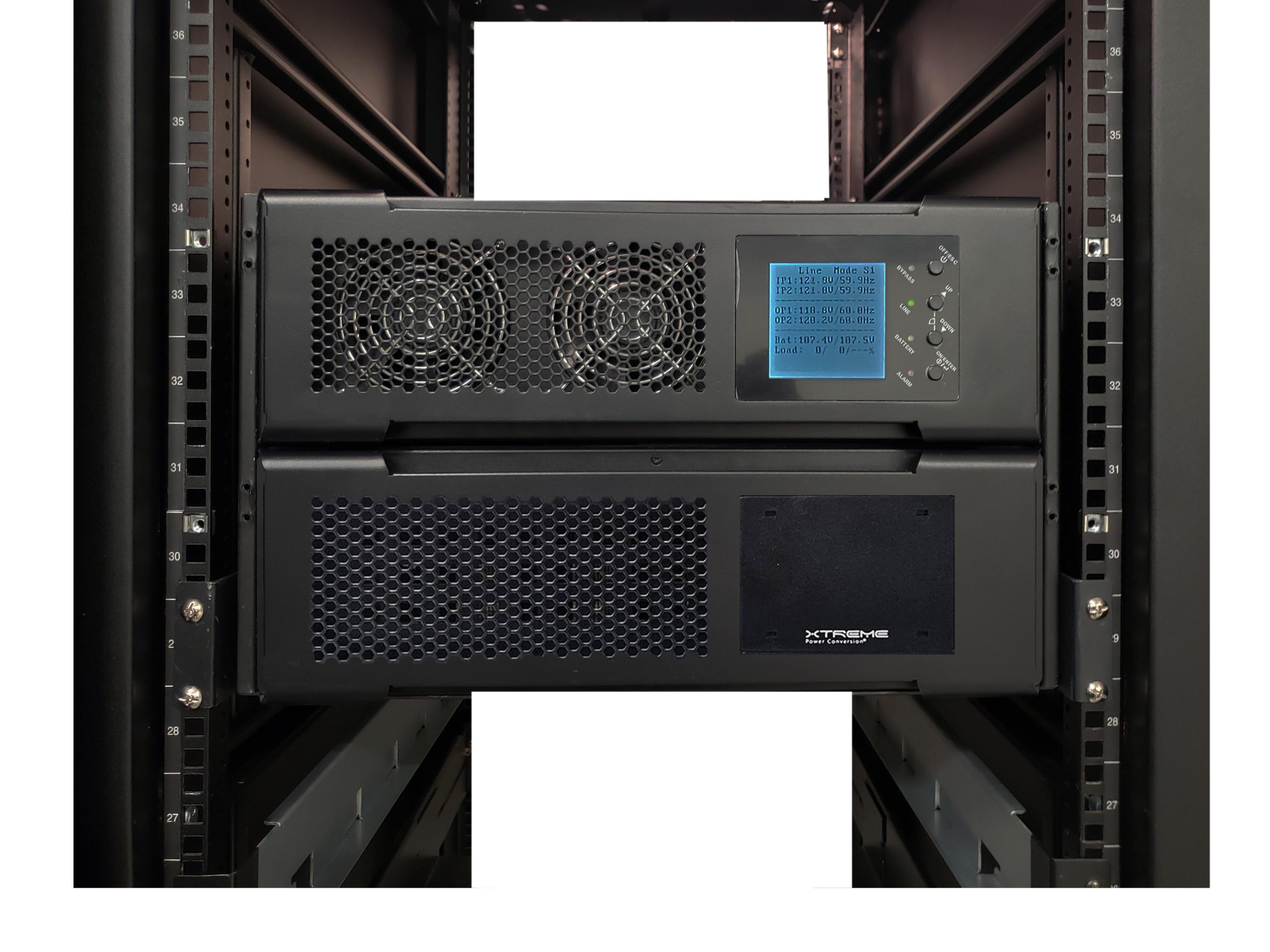
The Xtreme Power Conversion M90S defines a modern modular single-phase UPS architecture — engineered to support scalable infrastructure continuity across distributed and centralized electrical environments operating on split-phase power.
Designed for modernization strategies where lifecycle serviceability, phased capacity growth, and electrical-infrastructure constraints all have to be balanced, the M90S lets continuity systems evolve without disruptive replacement or a forced transition to three-phase distribution. Modular continuity architecture turns power protection into a scalable engineering framework aligned with real-world infrastructure growth.
Why modular single-phase architecture exists
Load density keeps rising in places that were built around rack-level UPS: telecom aggregation nodes, distributed compute rooms, broadcast facilities, clinical electrical support and large residential technology installations.
A fixed-capacity UPS answers that growth badly. When the load outgrows the box, the box gets replaced, and the money spent on the first one does not carry forward. The alternative has usually been more small UPS, which multiplies batteries to track, service visits to schedule and failure points to cover. Modular changes what gets bought: one enclosure, then capacity in 6 kW blocks as the load arrives, with each power module and battery module serviceable on its own.
Split-phase infrastructure constraints
Many facilities run 208/120V or 240/120V service, and moving to three-phase is impractical for reasons that have nothing to do with the UPS:
- Building electrical design limits
- Service upgrade cost and disruption
- Constrained electrical rooms
- Distributed facility layouts
- Modernization budgeted in phases
A modular single-phase platform lets those sites centralize protection without rebuilding the electrical system.
Centralized, distributed, or both
Centralized deployment puts one M90S in the electrical room and protects several loads from it, which gives one runtime calculation, one battery lifecycle to manage and one service workflow. Distributed deployment places smaller M90S systems near the loads they serve, which suits phased expansion and keeps each site independent.
Most campus, telecom and multi-building sites end up with both: centralized where the load is dense, distributed at the edges. Because every tier uses the same 6 kW blocks and the same modules, a mixed estate still carries one spare parts list.
One 6 kW block, five enclosures
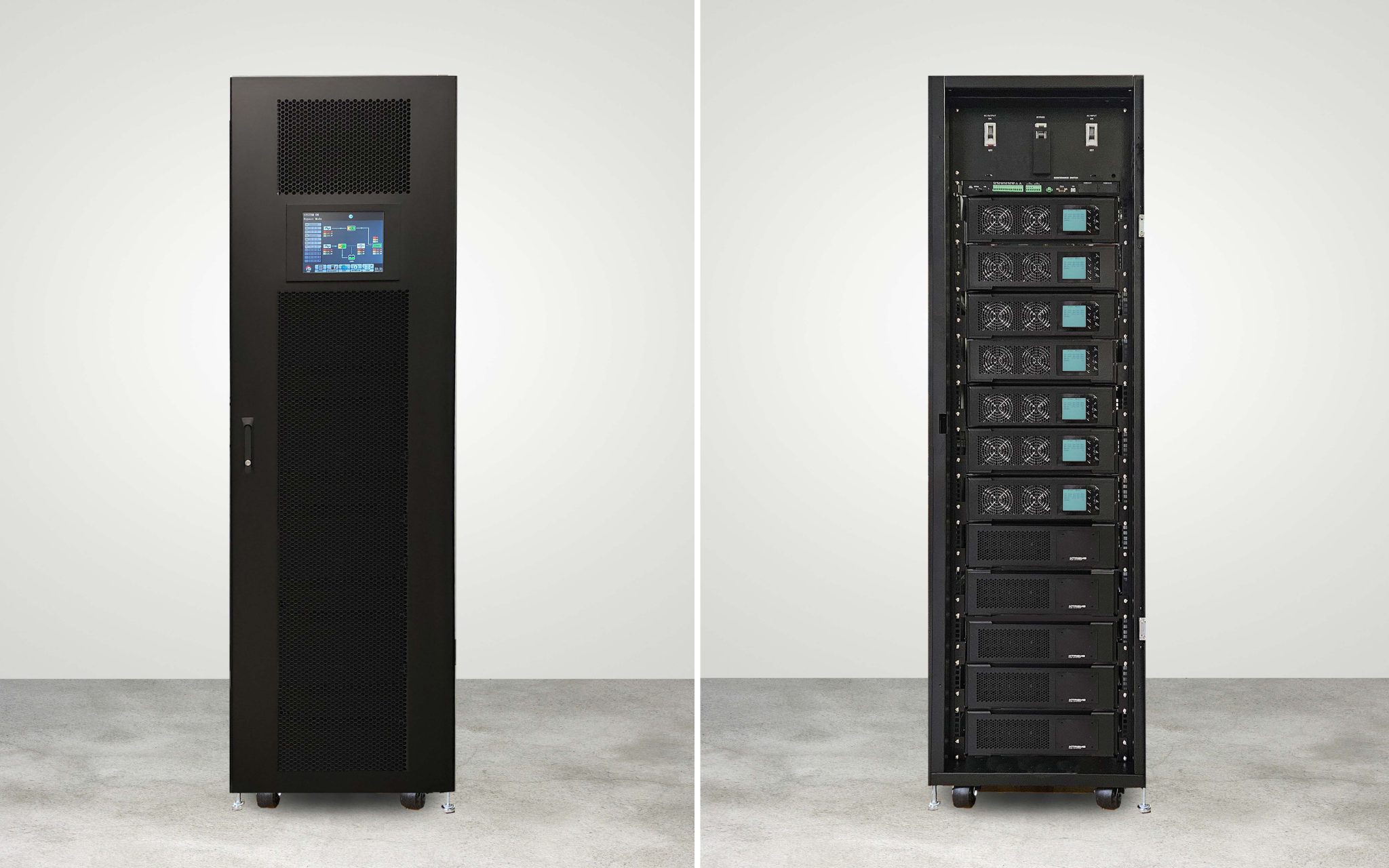
Every M90S is built from the same 6 kW power module and the same battery module. The enclosure decides how many slots are available; the modules are identical across the family. Capacity is added a block at a time, redundancy is a matter of installing one more module than the load needs, and a failed subsystem is replaced rather than the system.
Slots are universal: planners allocate them between power and battery modules to trade capacity against runtime. A working system needs at least one power module and at least one battery module.

Unity power factor and integral bypass
The M90S delivers unity output power factor, so rated kVA equals usable kW. Platforms rated at 0.8 or 0.9 PF force the buyer to oversize to reach the same watts, and that oversizing is paid for in equipment, rack space and cooling.
What unity power factor is worth
A 24 kW load needs 24 kVA of M90S capacity: four 6 kW blocks, one enclosure. The same load on a platform rated 0.9 PF needs 26.7 kVA, which in practice means buying the next size up.
The gap widens as the load grows. At 48 kW the 0.9 PF equivalent is 53.3 kVA, so the oversizing is more than a full 6 kW block of capacity that never serves a watt of load.
A wrap-around maintenance bypass is built into the frame rather than bolted on beside it. Service can transfer the critical load to utility power without dropping it, and without an external bypass panel, its wall space, its conduit and its separate service procedure.
Single-phase vs. three-phase
- Facility electrical service remains split-phase
- Aggregated load density exceeds distributed-UPS practicality
- Phased infrastructure growth is required
- Modernization must avoid electrical reconstruction
- Infrastructure density exceeds practical single-phase aggregation limits
- Electrical-room design supports higher-capacity centralized continuity
- Enterprise-scale infrastructure expansion is anticipated
Need three-phase power? See the Xtreme Power M90C modular three-phase UPS.
What modular changes about the spend
The case for modular is usually financial rather than electrical. Four things change:
Capacity is bought when it is needed. The enclosure is purchased once and populated over time, so capital tracks the load instead of anticipating it by several years.
Nothing is bought to cover power factor. Unity PF means no capacity purchased purely to reach a watt figure.
Renewal happens at the subsystem. An aging battery module or a failed power module is replaced on its own. The enclosure, the bypass and the distribution stay in service, and the replacement is a spare off a shelf rather than a project.
One spares list covers the estate. Because every tier uses the same modules, a site running a 2S in one closet and a 12S in the electrical room stocks one power module and one battery module as spares.
Xtreme Power sells through resellers, so pricing comes from your distributor. We can put together a budgetary configuration and capacity plan to quote against.
M90S models at a glance
| Model | Slots | Capacity | Redundancy | Output |
|---|---|---|---|---|
| M90S-2S | 2 | 6 kW fixed | None (single power module) | 208/120V or 240/120V |
| M90S-4S | 4 | 6 to 12 kW | N+1 available | 208/120V or 240/120V |
| M90S-6S | 6 | 6 to 24 kW | N+1 available | 208/120V or 240/120V |
| M90S-12S | 12 | 6 to 48 kW | N+1 available | 208/120V or 240/120V |
| M90Si-6S | 6 | 6 to 30 kVA | N+1 available | 208/230V |
Every tier uses the same 6 kW power module and battery module. Slots are allocated between power and battery to trade capacity against runtime, so usable capacity depends on the runtime configured. Model pages carry dimensions, runtimes and distribution options.
The M90S modular tiers
A standardized framework that scales with infrastructure demand while maintaining platform consistency:
Plan with confidence
M90S modular UPS — frequently asked questions
What is the M90S?
How does the M90S scale capacity?
What is the difference between centralized and distributed M90S deployment?
Does the M90S support split-phase power?
When should I choose single-phase modular over three-phase?
How is the M90S priced?
Build continuity that scales with your facility
Define the modular continuity architecture aligned with your facility modernization strategy, infrastructure growth trajectory, and operational resilience objectives.