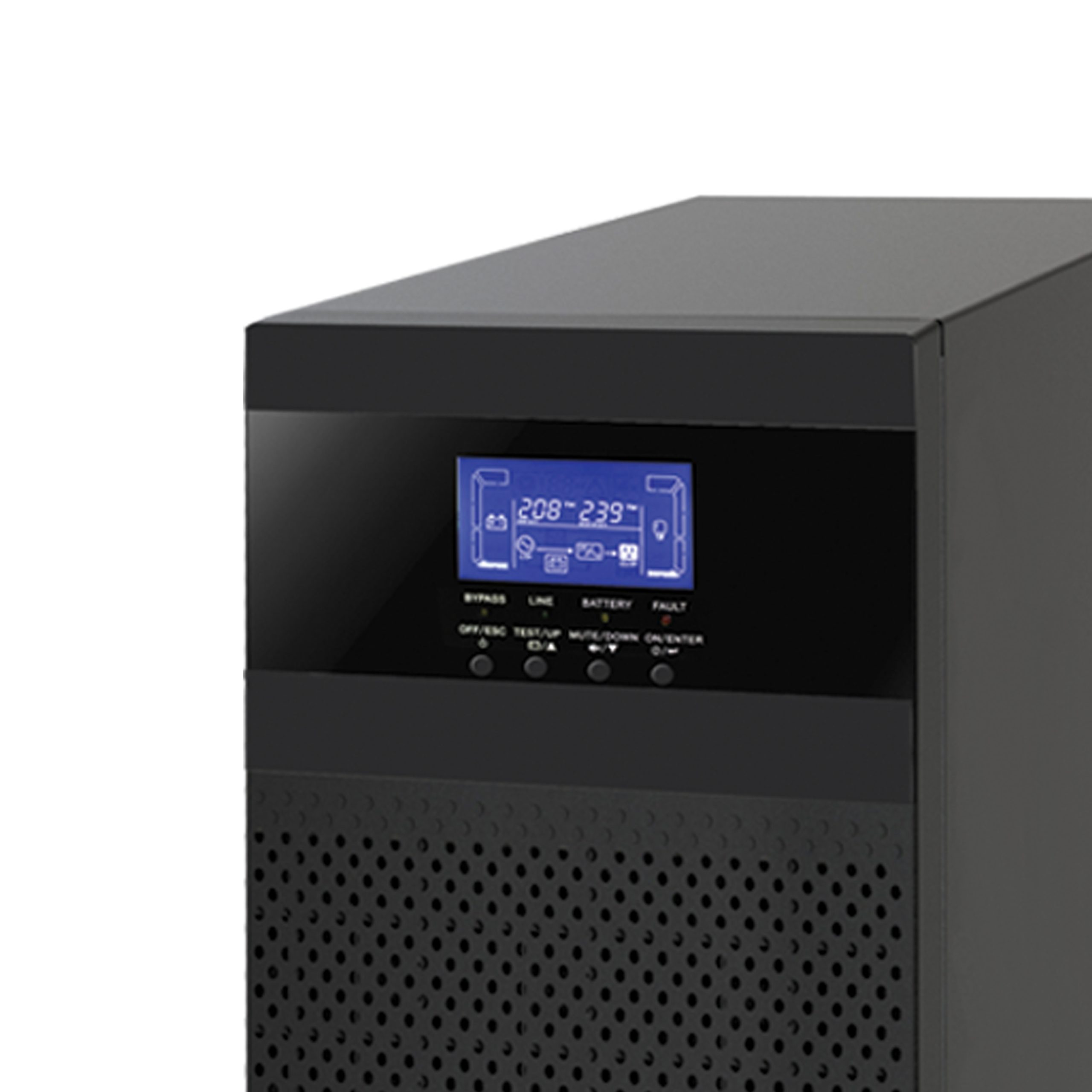

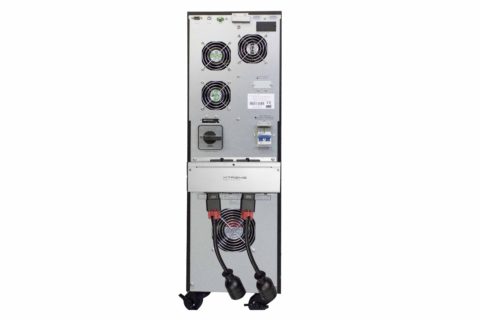


TX91 Isolation Online UPS – Laboratory & Precision Power UPS (3.8–10kVA, 120/240V)
3.8–10 kVA | 240/120V or 230/115V | Online Double-Conversion UPS with Isolation Transformer
Isolation-based online UPS engineered for laboratory instrumentation, analytical systems, and precision electronic environments requiring superior power quality, electrical noise mitigation, and measurement stability.
3.8–10 kVA · 240/120 VAC (or 230/115V) · Isolation Online Double-Conversion Tower UPS · TAA
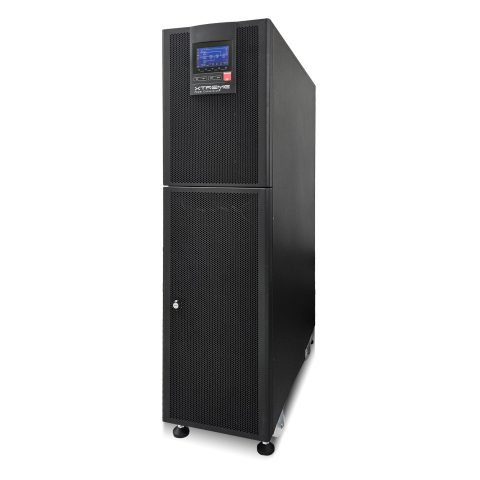
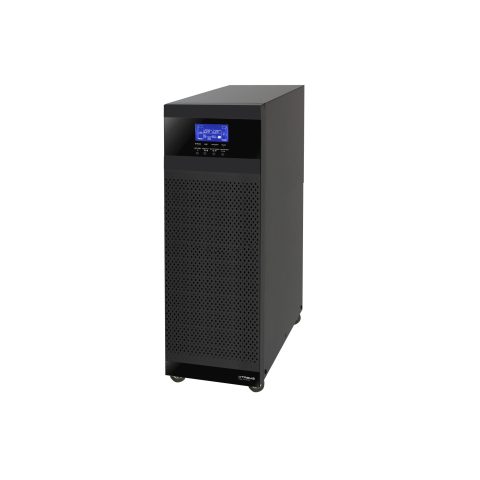
TX91 isolation online UPS
The TX91 is an isolation-based online double-conversion tower UPS (3.8 to 10 kVA) engineered for laboratory instrumentation, analytical systems, and precision electronics — environments where electrical noise, grounding instability, and waveform distortion directly affect measurement accuracy and reliability. An integrated galvanic isolation transformer, standard on every TX91, electrically separates the utility input from the load, eliminating common-mode noise that transformerless designs leave exposed. True sine wave output, ±1% regulation, ANSI/IEEE C62.41 surge protection, dual output voltages, a 3-year warranty (USA and Canada) with a $50,000 load protection policy, and TAA compliance.

Power-quality-first protection for precision environments
The TX91 is the power-quality-first UPS platform for environments where electrical noise and grounding conditions directly impact system performance. It is built for applications where standard, IT-focused UPS platforms do not provide sufficient electrical isolation — analytical laboratories, measurement and control systems, and sensitive electronic instrumentation. Beyond conventional online protection, the TX91 conditions power at the source through galvanic isolation, improving waveform integrity and stabilizing operating conditions for sensitive loads.
Galvanic isolation that conditions power at the source
Unlike transformerless UPS platforms, the TX91 incorporates an integrated galvanic isolation transformer, standard on every model, that electrically separates the utility input from connected loads — and provides power conditioning during both normal and bypass operation. This architecture mitigates the disturbances that degrade precision measurement:
| Disturbance | How isolation addresses it |
|---|---|
| Common-mode electrical noise | Galvanic separation breaks the common-mode path between source and load |
| Harmonic propagation | Isolation limits harmonic coupling from shared loads on the same supply |
| Ground reference instability | A stabilized ground reference supports sensitive instrumentation |
| Voltage transient propagation | Transients are attenuated rather than passed through to the load |
The result is improved waveform integrity, a stable ground reference, and repeatable operating conditions — without the expensive dedicated circuits a non-isolated approach would require.
What the TX91 delivers
Eliminates common-mode noise left exposed by transformerless online designs, removes the need for expensive dedicated circuits, and provides power conditioning during both normal and bypass operation.
High-quality true sine wave output with tight ±1% voltage regulation for precision electronics — with dual output voltages (240/120V, or 230/115V) and an optional configurable PDU for a wide range of receptacle requirements.
Surge withstand to Category A & B (6kV / 200 & 500A, 100kHz ringwave) with very low let-through — under 10V normal mode (L-N) and under 0.5V common mode (N-G) at 6kV Cat A.
A manual maintenance bypass transfers the load to utility power for service, and a static switch automatically transfers output to the isolated bypass source on overload or fault.
Optional 580W internal batteries (XR models) and external BP960 battery cabinets extend runtime — from ride-through and controlled shutdown to longer backup for generator transfer events.
Isolated online operation protects against all ten common power problems, with auto restart, LCD monitoring of vital parameters, and compatibility with generator-backed infrastructure.
The isolation tier of the Xtreme Power family
The TX91 sits where power quality and electrical isolation are primary design requirements, rather than IT-grade load protection alone. For isolated online voltage regulation without internal batteries, the TXVR is the companion platform.
Need isolated online voltage regulation without internal batteries? See the TXVR.
Beyond IT-grade online UPS
Standard online UPS systems are designed primarily for IT load protection and do not address electrical noise or grounding instability to the same degree. Transformerless platforms prioritize efficiency and compact size but provide no electrical isolation between input and output. The TX91 adds galvanic isolation that improves power quality at the source — suited to environments where measurement accuracy is affected by electrical noise, ground-reference variation impacts performance, or instrumentation sensitivity exceeds IT-grade requirements.
| Capability | TX91 (isolation online) | Conventional / transformerless online |
|---|---|---|
| Electrical isolation | Galvanic isolation transformer (standard, integrated) | None (input and output share reference) |
| Common-mode noise | Eliminated at the transformer | Passed through to the load |
| Ground reference | Stabilized for instrumentation | Follows upstream conditions |
| Primary design goal | Power quality for precision loads | IT load protection / efficiency |
Four models, 3.8–10 kVA
| Model | Capacity (kVA / kW) | Weight | Battery (standard / XR) |
|---|---|---|---|
| TX91-3.8K | 3.8 / 3.8 | 272 lbs | (20) 12V 9AH / 12V 580W (XR) |
| TX91-5K | 5 / 5 | 275 lbs | (20) 12V 9AH / 12V 580W (XR) |
| TX91-6K | 6 / 6 | 278 lbs | (20) 12V 9AH / 12V 580W (XR) |
| TX91-10K | 10 / 10 | 307 lbs | (20) 12V 9AH / 12V 580W (XR) |
All models are tower form factor, 9.9 × 23.3 × 32.4 in, with unity output power factor, ±1% regulation, and a 273 VDC charger (1–4 A selectable). Input and output land on terminal blocks or an optional configurable PDU. Runtime extends via XR internal batteries and external BP960 battery cabinets. (6 kVA system capacity is reduced by a 30 A input circuit; the PDU L6-30P input option is 6 kVA only.)
Runtime by battery configuration and load
Estimated runtime in minutes at 50% and 100% load, by battery configuration — from the standard internal battery and the high-rate XR internal battery through external BP960 battery cabinets in increasing quantity.
| Model | Internal battery | XR Internal | + BP960-1 | + BP960-2 | + BP960-3 | + (2) BP960-2 | + (2) BP960-3 | + (3) BP960-3 | ||||||||
|---|---|---|---|---|---|---|---|---|---|---|---|---|---|---|---|---|
| Percentage load: | 50% | 100% | 50% | 100% | 50% | 100% | 50% | 100% | 50% | 100% | 50% | 100% | 50% | 100% | 50% | 100% |
| TX91-3.8K | 37 | 15 | 48 | 21 | 92 | 38 | 140 | 64 | 198 | 94 | 258 | 120 | 403 | 172 | 572 | 265 |
| TX91-5K | 26 | 10 | 35 | 15 | 64 | 26 | 106 | 45 | 142 | 65 | 186 | 89 | 279 | 126 | 443 | 190 |
| TX91-6K | 20 | 8 | 28 | 12 | 40 | 21 | 87 | 35 | 119 | 51 | 149 | 70 | 224 | 105 | 349 | 153 |
| TX91-10K | 9 | 3 | 14 | 6 | 23 | 10 | 39 | 18 | 58 | 26 | 79 | 35 | 116 | 55 | 170 | 89 |
Runtimes are shown in minutes and vary with battery condition, age, cycles, and ambient temperature. The TX91 is designed primarily for power-quality stabilization and controlled shutdown — ride-through, controlled instrument shutdown, and stabilization during generator transfer. Contact Xtreme Power at (800) 582-4524 or sales@xpcc.com for runtime sizing.
Where the TX91 is deployed
The TX91 is deployed where electrical noise, grounding conditions, and waveform quality directly affect system performance — analytical laboratory instrumentation, mass spectrometry, pharmaceutical and research facilities, industrial measurement and control, semiconductor environments, retail, and harsh electrical infrastructure. Organizations modernizing laboratory and research infrastructure adopt isolation UPS to standardize power quality, improve measurement repeatability, and reduce instrument fault incidence.
TAA-compliant power protection
The TX91 supports regulated laboratory and government deployments requiring Trade Agreements Act compliance, alongside UL1778, cUL, FCC Class A, and RoHS.
TX91 specifications
| Models | TX91-3.8K / -5K / -6K / -10K (3.8 / 5 / 6 / 10 kVA = kW) — unity PF |
| Topology | Online double-conversion, single-phase; integrated galvanic isolation transformer, standard |
| Input | 208 VAC nominal (220 / 230 / 240 VAC optional); range 110–300 VAC; 46–64 Hz auto-sensing; terminal blocks or optional PDU |
| Output | 240/120 VAC (alternate voltages available); ±1% regulation; 50/60 Hz ±0.1 Hz; true sine wave |
| Efficiency | Up to 97% ECO mode, 91% online mode |
| Overload | 110% for 10 min; 130% for 1 min; >130% for 1 s |
| Surge let-through | <10V normal mode (L-N), <0.5V common mode (N-G) at 6kV ANSI/IEEE C62.41 Cat. A |
| Surge withstand | ANSI/IEEE C62.41 Category A & B; 6kV / 200 & 500A, 100kHz ringwave |
| Battery | Sealed maintenance-free lead acid; (20) 12V 9AH standard or (20) 12V 580W (XR); charger 273 VDC, 1–4 A selectable |
| External battery packs | BP960-1 (20 × 12V 9AH), BP960-2 (40), BP960-3 (60); 9.9 × 23.3 × 32.4 in |
| Bypass / transfer | Manual maintenance bypass; static switch to isolated bypass on overload or fault; auto restart |
| Dimensions / weight | 9.9 × 23.3 × 32.4 in (tower); 272 / 275 / 278 / 307 lbs (3.8 / 5 / 6 / 10 kVA) |
| Communications | RS-232, EPO; intelligent slot (Web/SNMP, Relay/dry contact, Modbus); USB |
| Environment | 32–104°F (0–40°C); audible noise <50 dBA; altitude 5,200 ft |
| Approvals | UL1778, cUL, FCC Class A, RoHS, TAA compliant |
| Warranty | 3 years electronics, 3 years battery (USA and Canada); 1 year outside the USA and Canada; $50,000 load protection policy (USA and Canada); 5-year extended available |
| Options | Output PDU, input L6-30P cord (3.8 / 5 / 6 kVA), external BP960 battery cabinets, 5-year extended warranty |
TX91 isolation UPS — frequently asked questions
Is the isolation transformer standard on the TX91?
Yes. Every TX91 ships with the integrated galvanic isolation transformer; it is not an option to specify. Where isolation is wanted on a conventional online UPS instead, it is available as an option on the P91 5–10K. The TX91L shares the TX91 isolation architecture and moves all runtime to external battery systems.
What is the difference between the TX91 and the TX91L?
Battery architecture. The TX91 has internal batteries with optional XR high-rate packs and external BP960 cabinets, and is built for short-duration ride-through and controlled instrument shutdown. The TX91L has no internal batteries at all; runtime is delivered entirely by external battery systems sized to the site, spanning minutes to multiple hours. Same isolation architecture, different runtime strategy.
What size TX91 do I need for a laboratory instrument?
Most single-instrument installations with auxiliary equipment, such as an HPLC pump, autosampler, and data system, land between 3.8 and 10 kVA, which is the full TX91 range. Output power factor is unity, so kVA equals kW and nameplate wattage maps directly. Confirm against the instrument nameplate and the auxiliary load before ordering.
How much runtime does the TX91 provide?
It depends on model, load, and battery configuration. At 50% load the standard internal battery gives roughly 37 minutes on the 3.8 kVA and 9 minutes on the 10 kVA. High-rate XR internal batteries and external BP960 cabinets extend that substantially. The full matrix is in the runtime table above. The TX91 is designed primarily for ride-through, controlled shutdown, and stabilization during generator transfer rather than long-duration backup.
Can the TX91 run from a generator?
Yes. Online double-conversion regenerates the output frequency, so the TX91 accepts generator power rather than rejecting it as out of tolerance the way a standby or line-interactive unit would. Auto restart and static bypass to the isolated bypass source support generator-backed infrastructure.
Does the TX91 need a dedicated circuit?
Not usually, and avoiding one is part of the point. A non-isolated approach often requires an expensive dedicated circuit to get a clean ground reference; the isolation transformer establishes that at the UPS instead. Note that on the 6 kVA model, system capacity is reduced by a 30 A input circuit, and the L6-30P input cord option applies to 6 kVA only.
Is the TX91 TAA compliant?
Yes. The TX91 is TAA compliant and carries UL1778, cUL, FCC Class A, and RoHS, which supports regulated laboratory and government procurement.
What does the isolation transformer actually protect against?
Common mode noise, which is measured between ground and either neutral or line. It is the tenth of the ten common power problems and the only one that online double-conversion alone does not address. Galvanic separation breaks the common mode path between source and load, limits harmonic coupling from shared supplies, and stabilizes the ground reference that sensitive instrumentation depends on.
Documents and related links
Plan your TX91 deployment
Talk to an Xtreme Power specialist about isolation requirements, runtime sizing with XR internal and BP960 battery cabinets, PDU and receptacle configuration, and TAA-compliant deployment for laboratory, analytical, industrial, and precision power environments.